

What Is the Difference Between Hexane and N-Hexane?
August 31, 2026
N-hexane is a specific hydrocarbon, while commercial hexane typically refers to a mixture of n-hexane and other closely related hydrocarbons.
Industrial buyers sometimes use hexane and n-hexane interchangeably, but that shorthand can create real safety and compliance problems. The concentration of n-hexane can affect exposure concerns and regulatory requirements, while solvent composition can influence performance. For formulators, purchasing teams, and EHS professionals, knowing what is actually in the solvent is an important first step toward selecting or replacing it.
What Hexane and N-Hexane Actually Are
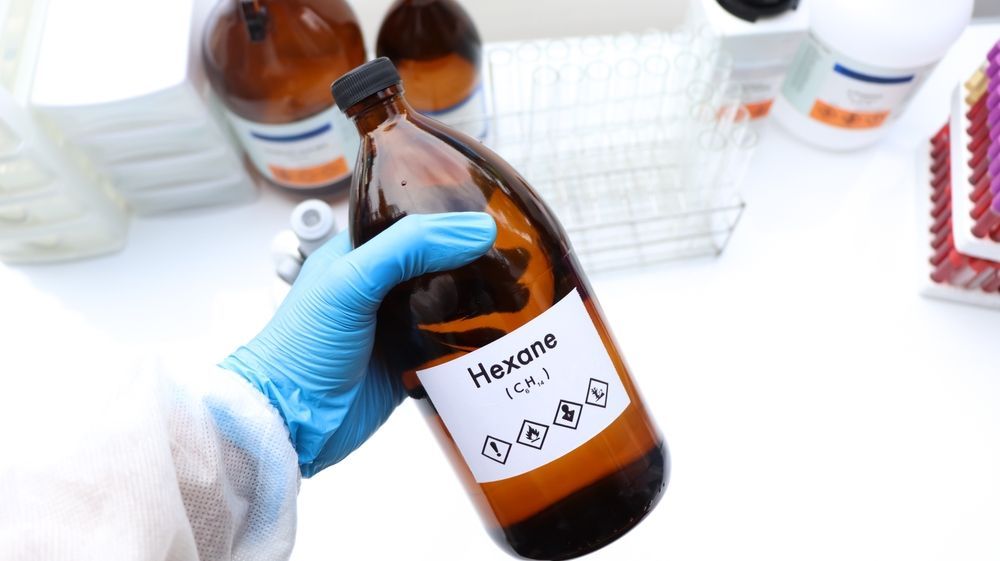
N-hexane is a single chemical compound, specifically a straight-chain hydrocarbon containing six carbon atoms. Commercial hexane, sometimes labeled "hexanes," is generally a petroleum-derived mixture containing n-hexane plus other C6 hydrocarbons, such as methylpentanes and methylcyclopentane.
That distinction matters when comparing hexane vs. n-hexane for industrial use. Two solvents sold under similar names may have different compositions and performance characteristics. Rather than relying on the name alone, formulators should check the CAS number, product specifications, and Safety Data Sheet (SDS) to understand the solvent's composition before assessing exposure requirements or potential substitutes.
Inside N-Hexane: Properties and Health Risks
N-hexane offers nonpolar solvency and rapid evaporation, making it useful across many industrial processes. Its low boiling point and high volatility shape its performance, but they also increase the potential for vapor exposure. Its known neurotoxicity adds another concern, particularly when exposure occurs repeatedly over time.
Physical Properties: Boiling, Vapor, Flash Points
N-hexane boils at approximately 69°C (156°F) and has a high vapor pressure, so it evaporates quickly at room temperature. Its flash point is approximately -22°C (-8°F), making it highly flammable. These properties can benefit processes requiring fast solvent release, but they also affect ventilation, solvent loss, ignition control, and storage practices.
Neurotoxicity and Peripheral Neuropathy
Repeated n-hexane exposure is associated with peripheral neuropathy, a form of nerve damage that can cause numbness, tingling, weakness, and reduced coordination in the hands and feet. The concern is linked to 2,5-hexanedione, a metabolite produced when the body processes n-hexane.
For industrial operations, exposure can occur through inhalation of solvent vapors and skin contact. Processes involving frequent solvent use, open containers, or inadequate ventilation can increase the potential for repeated exposure.
Why Commercial Hexane Isn't Automatically Safer
Commercial hexane may contain less n-hexane than a high-purity n-hexane solvent, but that does not automatically make it a safer choice. The proportion of n-hexane varies among commercial mixtures, and other hydrocarbons introduce their own flammability and exposure considerations.
For purchasing and EHS teams, the product name alone provides too little information. Reviewing the SDS and composition data reveals how much n-hexane is present and which hazards apply to the material actually entering the facility.
Regulatory Status: HAP, OSHA PEL, and Prop 65
N-hexane is listed as a hazardous air pollutant (HAP) under the Clean Air Act. Federal OSHA sets an 8-hour permissible exposure limit (PEL) of 500 ppm, while NIOSH recommends 50 ppm. California's occupational limit is also 50 ppm.
California also lists n-hexane under Proposition 65 for male reproductive toxicity. These distinctions reinforce why buyers should verify the composition of commercial hexane rather than apply n-hexane requirements to every hexane mixture indiscriminately. Regulatory obligations can depend on the material, concentration, process, and facility location.
Industrial Uses: Where Each Solvent Shows Up
Commercial hexane is used in industrial cleaning, adhesives, coatings, inks, and extraction processes, including vegetable oil processing. Its ability to dissolve oils, greases, and other nonpolar materials makes it useful across very different production environments.
Higher-purity n-hexane is also used when tighter composition control is needed, including certain laboratory and extraction processes. For formulators considering a hexane substitute, the application matters more than the solvent name. A replacement for adhesive formulation may require different solvency, evaporation, and compatibility characteristics than one intended for cleaning or extraction.
Bio-Based Alternatives to Hexane and N-Hexane
Replacing hexane starts with identifying the function it performs in the process, such as dissolving oils, controlling evaporation, cleaning equipment, or supporting an adhesive formulation. A potential alternative should then be evaluated against those specific performance requirements.
Available through Vertec BioSolvents under Shrieve Chemical, the
VertecBio™ ELSOL® and VertecBio™ EL product lines offer
bio-based solvent options for industrial formulation and cleaning applications. Each product line contains multiple solvent solutions developed for different performance requirements and applications.
Vertec does not designate one ELSOL® product as a universal hexane substitute. Its technical team can recommend an appropriate product based on the customer's current hexane grade, application, performance targets, and process conditions.
Ready to Replace Hexane in Your Formulation?
A successful hexane substitution depends on how closely the alternative matches the performance requirements of the existing process. Solvency, evaporation rate, substrate compatibility, drying behavior, flash point, and final product quality are useful starting points for testing.
Vertec BioSolvents under Shrieve Chemical can help identify
options from the VertecBio™ ELSOL® and VertecBio™ EL product lines based on your specific application.
Contact us to discuss your formulation, evaluate potential alternatives, or request a sample for testing.